TikTok launches a standalone shopping app
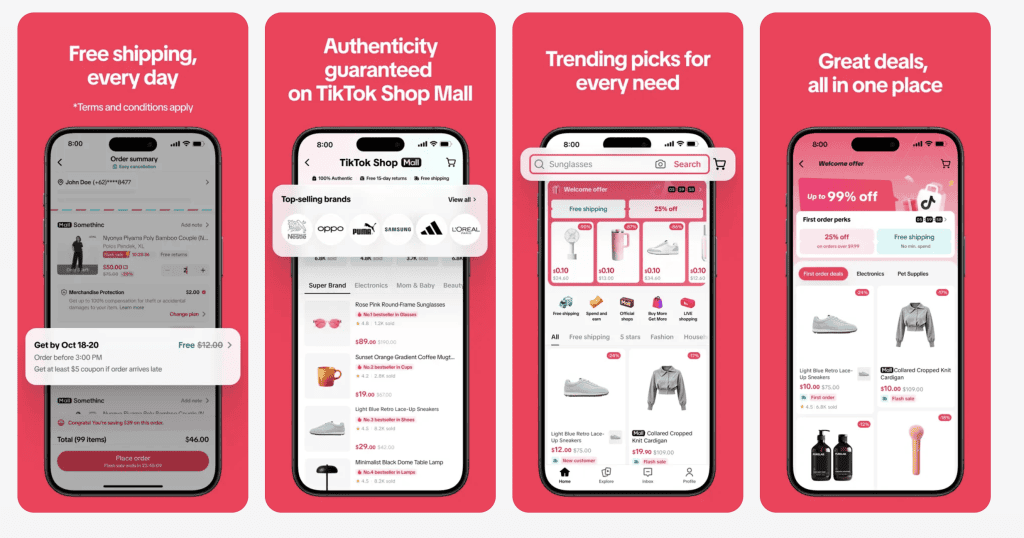
Image credit: TikTok
The story:
- TikTok has launched a standalone shopping app in Singapore, Thailand, Malaysia and the Philippines, giving users a dedicated space to browse and buy products.
- The app brings together product listings, personalised recommendations and shoppable video content, offering a shopping-focused experience separate from the main TikTok app.
- The launch marks a further expansion of TikTok’s social commerce offering, with a dedicated app focused on product discovery and purchasing.
So what?
TikTok is making another big bet on social commerce, but this time it’s separating shopping from the main entertainment space.
That’s an interesting move for a platform built around people discovering products when they weren’t necessarily looking to buy anything.
For brands, the question is whether a dedicated shopping app can recreate that impulse-buying behaviour.
If it takes off, marketers may need to think about TikTok as both a content platform and a standalone retail destination.
2. LinkedIn cracks down on AI-generated comments
Credit: Hari Srinivasan Chief Product Officer Linkedin
The story:
- LinkedIn is updating how it ranks comments to reduce the visibility of replies it suspects have been generated by AI.
- Suspected AI comments will be treated as less relevant, meaning they are less likely to appear prominently when comments are ranked by “Most relevant”.
- LinkedIn says testing has already led to a 20%+ reduction in views of low-quality AI comments, as it continues its wider push against “AI slop”.
So what?
LinkedIn is drawing a clearer line between using AI to improve content and using it to manufacture engagement.
For brands and social teams, generic AI-generated comments could now actively work against visibility rather than help it.
That makes genuine, specific interaction more valuable, particularly for employee advocacy and thought leadership where comments are often used to extend reach.
The takeaway is simple: AI can help shape the response, but if every comment sounds like “Great insights!”, LinkedIn increasingly doesn’t want to show it.
3. Instagram is offering creators up to $500,000 for long-form videos
The story:
- Instagram is reportedly offering selected creators one-off payments of up to $500,000 to produce long-form video content for its new Features format.
- The platform is promoting Features through prominent placements in Explore, giving participating creators additional visibility for their videos.
- The initiative represents Instagram’s latest attempt to attract long-form creators and expand its video offering beyond Reels, putting it in more direct competition with YouTube.
So what?
Instagram has spent years pushing short-form video, so it’s interesting to see it throwing serious money at longer content.
But paying creators to make videos is one thing. Getting audiences to watch them is another.
For brands, this could open up opportunities for deeper storytelling, documentaries and longer creator partnerships.
The real test is whether Instagram can build the viewing habits that have made long-form content work so well on YouTube.
4. Instagram adds Amazon affiliate links
Credit: Amazon Influencer Program
The story:
- Instagram has partnered with Amazon to let eligible creators add Amazon affiliate links directly to Reels and feed posts.
- Creators can add up to 30 products per Reel and 20 per feed post, with links taking viewers directly to the Amazon Shopping app.
- Sales are attributed back to the creator, who earns commission through their connected Amazon Influencer account.
So what?
Instagram is making creator content more directly shoppable without trying to own the transaction itself.
For brands, that shortens the gap between discovery and purchase and gives creators another reason to build product recommendations into their content.
It also means affiliate performance could become a more important part of how brands assess creator partnerships, rather than relying purely on reach or engagement.
Amazon now has similar affiliate partnerships with YouTube and Pinterest too, showing how quickly social platforms are becoming another storefront for the retailer.
5. Instagram tests a “Show All” button for Stories
Credit: Sparq
The story:
- Instagram has previously tested a feature that hides additional Stories behind a “Show All” button, rather than displaying every Story from an account immediately.
- Users can still publish multiple Stories, but viewers would need to tap “Show All” to access the remaining content.
- The test introduces an extra step for viewers watching longer Story sequences, potentially changing how audiences interact with accounts that post frequently.
So what?
Instagram could be making brands work harder to keep people watching Stories.
If users have to actively choose to see more, posting ten Stories in a row might not guarantee the attention it once did.
For social managers, that puts more pressure on the opening frames to grab attention and give people a reason to continue.
It’s only a previously tested feature for now, but it’s a reminder that Story completion and retention matter more than simply publishing more content.
6. Meta launches a standalone messaging app for teens

The story:
- Meta is testing Direct, a standalone messaging app aimed at teenagers that takes Instagram DMs into a separate platform.
- The app includes tools such as drawing on chats, Notes, stickers and voice effects, alongside Meta’s parental supervision and teen safety measures.
- Meta is testing Direct in markets including Turkey and Thailand, as teen social media restrictions expand and Snapchat’s user growth slows in the US and Europe.
So what?
Meta is betting that messaging could become an even bigger part of how younger audiences use social platforms.
The timing is interesting. Teen social media restrictions are tightening in some markets, while messaging apps can sit outside those rules.
For brands, this is less about immediate advertising opportunities and more about watching where younger users are choosing to spend their time.
If social behaviour keeps shifting towards private messaging rather than public feeds, community, customer service and direct conversations could become even more important parts of social strategy.
Like this? Read more